Doris Dillon
News of the WorldDoris Dillon is a friend and helper to Jefferson Kyle Kidd and Simon, but her most revealing role is her response to Johanna Leonberger. Asked to keep watch while Jefferson Kyle Kidd reads, she becomes more than a guard against the girl’s impulse to run away: she attends to the loneliness and cultural rupture that make the child’s doll matter. Her practical kindness and her account of Johanna’s inner dislocation meet in a rain-soaked supper beside the Curative Waters wagon.
Identity and Character
Doris is presented through work as much as through description. She finds plates in the cook box, lays out what utensils are available, and makes room for the meal on the wagon’s tailgate and boxes. The narrative describes her as small, with wrists made ropy by muscle and hard work; her hair is a striking Irish black, touched with blue lights. Simon remarks that her Irish comes out at unexpected moments, and her speech includes an Irish-inflected assent. These details connect her cultural identity to a voice and a body shaped by labor, rather than making it a mere label.
Her manner combines directness with tenderness. She tells Simon not to stare at Johanna, insisting that the girl’s strangeness is not a spectacle. When she finds Jefferson Kyle Kidd’s things scattered under hay, she gently tells him to pick them up and tries to smile. In both moments, she answers awkwardness without turning it into humiliation: she protects Johanna from scrutiny and meets Jefferson Kyle Kidd’s embarrassment with patience.
Care for Johanna
Jefferson Kyle Kidd explains that Johanna has lost familiarity with white people’s customs and asks Doris and her particular friend Simon to sit with the girl while he reads. He fears she may bolt if left alone. Simon considers the request and recognizes the underlying difficulty: Johanna wants to return to the people from whom she has been separated. The scene establishes Doris’s part in the fragile arrangement around the child—not as someone who can simply make her stay, but as someone trusted to keep her company while the adults reckon with her longing.
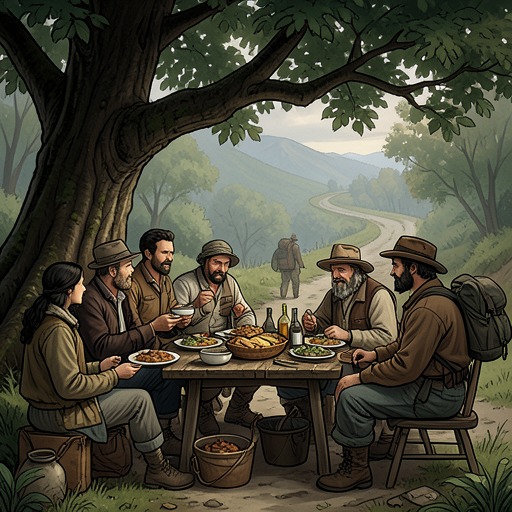
That trust takes concrete form when Jefferson Kyle Kidd, Simon, and Doris hurry through the drizzle to the wagon beneath the bur oaks. The canopy and side curtains shelter a supper Johanna has prepared: cornbread, bacon, and coffee. Doris removes her wet straw hat, finds the plates, and helps make the meal communal. The girl sits cross-legged between the long seats, with the gold lettering on the Curative Waters wagon shining in the lantern light. The ordinary tasks of eating and making room provide a brief, shared setting in which Johanna is present not only as a child to be watched, but as someone who has contributed to the meal.
The Doll and the “Second Creation”
The doll becomes the focus of Doris’s most searching interpretation. Simon thinks Johanna is addressing it as an idol; Doris resists reducing the girl’s behavior to that explanation. She sees the doll as resembling Johanna in its ambiguous status: neither simply real nor simply unreal, and still strange whatever clothing it is given. Her comparison makes the object a way of approaching the girl’s experience without claiming to explain it away.
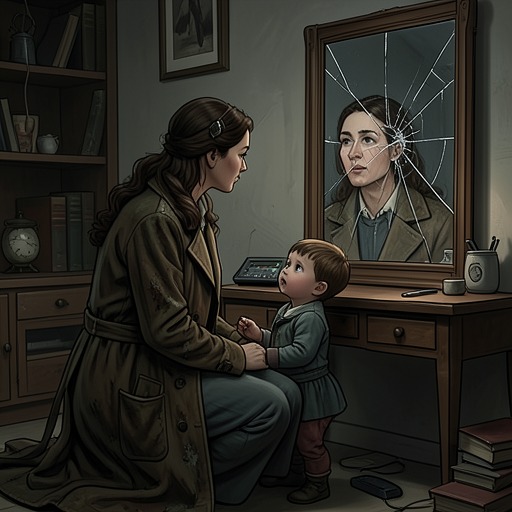
Doris describes Johanna as alone, twice captured, and swept along by forces beyond her control. She imagines a first creation as a turning of the soul toward the light and out of the animal world; a second creation, she says, can tear apart the making of the first, leaving a person in pieces. In this account, the doll’s significance is bound to a question of identity: Doris understands Johanna to be asking where the foundation of her former self can be found. The image does not repair the rupture. It gives the rupture a form that the adults can recognize, while preserving the strangeness Doris insists they should not dismiss.
Relationships and Narrative Role
Simon calls Doris the light of his life, a phrase that establishes her importance to him without specifying the terms of their relationship. He shares with her the request to watch Johanna, and Doris responds with both practical care and emotional attention. When she considers the girl’s isolation, tears suddenly burn in her eyes; she wipes them away with the back of her hand and continues setting out supper. Feeling does not displace the work of care but appears within it.
Jefferson Kyle Kidd also relies on Doris. Later, he formally asks her to stay the night with Johanna and offers her a dollar to compensate her. The narration reveals that he does not mention another reason: he would find it delightful to imagine Doris sleeping in the room next to his. Doris accepts, saying she is delighted to help. The invitation joins her established attentiveness to Johanna with Jefferson Kyle Kidd’s private hope, while her answer remains grounded in assistance. Across these scenes, Doris serves as a perceptive counterweight to explanations that would make Johanna’s behavior merely strange or disobedient: she notices the child’s vulnerability, protects her dignity, and treats an intimate attachment as evidence of a self struggling to remain whole.